
- A scenic ride from Kathmandu heads, toward the Machha Khola trailhead. The road climbs over hillsides passes quiet countryside towns and follows the Budhi Gandaki River.
- Rugged trail supported daily by authentic family-run teahouses offering affordable lodging and warm local hospitality.
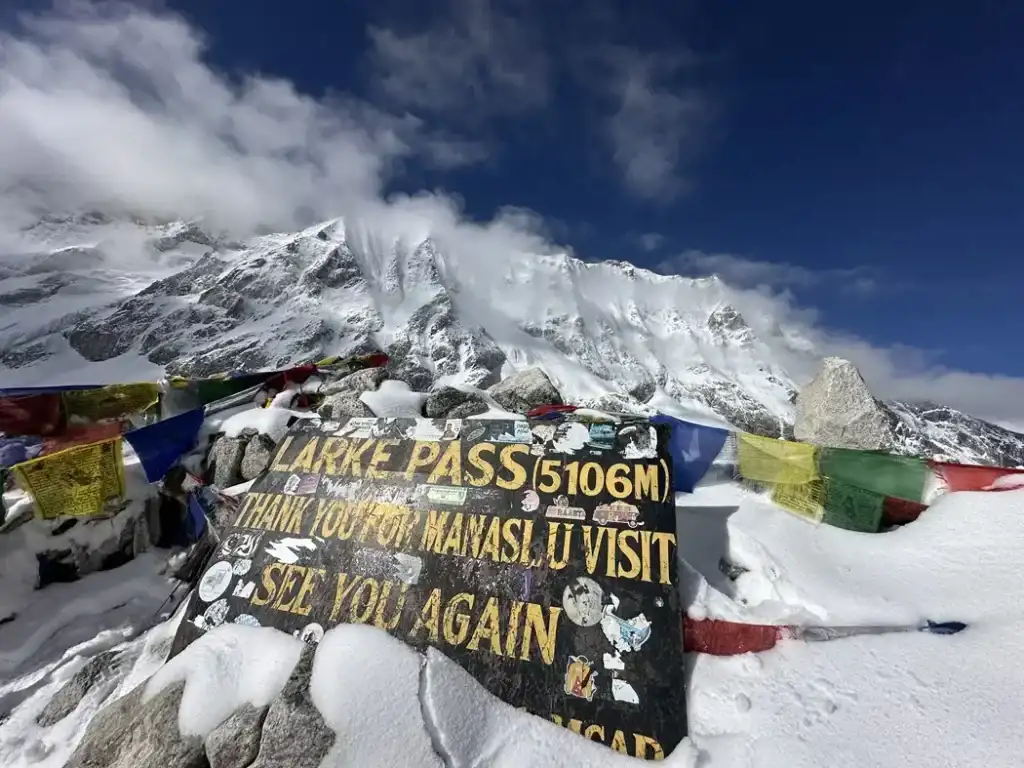
- Reach Larkya La Pass (5,106m) one of Nepal's most spectacular mountain passes connecting the Manaslu and Annapurna regions.
- Picturesque sceneries of Mt. Manaslu (8,163 m), Annapurna II (7,937 m), Himalchuli (7,893 m), Ngadi Chuli (7,871 m), Himlung Himal (7,126 m), Kang Guru (6,981 m), and Cheo Himal (6,820 m).
- Diverse cultural experiences showcasing the rich Tibetan-influenced heritage, customs, and mountain lifestyle of the local community.
- Tibetan Buddhist monasteries, including the pristine glacial Birendra Lake, historic chortens, long stone mani walls, and prayer wheels, such as the ancient Pungyen Gompa.
- Cross two regions, moving easily from the Manaslu to the Annapurna area.
Trip Duration
16 Days
Start / Finish
Kathmandu - Kathmandu
Max Altitude
Larkye La Pass (5,106m)
Best Seasons
March-May / September-November
Difficulty
Challenging
Meals
(Breakfast, Lunch and Dinner) during the trek
Accommodation
Tea House
Transportation
Private Tourist Vehicle
Trip Highlights
Overview
The Manaslu Circuit Trek is one of the best high-altitude wilderness loops in Nepal. This off-the-beaten-path journey around Mount Manaslu (8,163 m / 26,781 ft), the world’s eighth-highest summit, and combines magnificent Himalayan landscapes, deep river gorges and rich Tibetan Buddhist culture along the border with Tibet.
Important Trek Facts
Maximum Altitude: 5,106 m / 5,170 m (16,752 ft) Larkya La Pass
Trek Distance: From Machha Khola to Dharapani/Besisahar, around 160 to 180 km (110 miles)
Standard Duration: 13 to 16 days
Trek Difficulty: Strenuous / Challenging owing to continuous high altitude, 5-8 hours of walking everyday and rough moraine terrain
Best Seasons: Autumn (September to November) for crisp air and crystal-clear mountain views; Spring (March to May) for blossoming rhododendron forests.
Regulations and Licences
The territory is classed as a restricted area, as the trail crosses through sensitive border areas Trekkers need four permits:Manaslu Restricted Area Permit (MRAP): USD 100 per person for first 7 days in Autumn (+USD 15/day extra) USD 75 per person in Spring/Winter/Monsoon (+USD 10/day extra)
Manaslu Conservation Area Permit (MCAP): NPR 3,000 (~USD 23) each international trekker. Annapurna Conservation Area Permit (ACAP): NPR 3,000 (~USD 23) per foreign trekker. Chumnubri Rural Municipality Entry Permit: NPR 1,000 per person.
Solo Trekking Rule: Solo trekkers can acquire the restricted area permit on their own, without the need of forming a minimum group size of two. Trekking, however, is legally required to be done with a government-licensed guide, who must be booked through a recognised agency.
Transport & Highway Logistics
Trailhead Transport: Machha Khola (870 m / 930 m) start of hike. By car from Kathmandu (~140–160 km) it takes 8 to 10 hours via Dhading Besi and Arughat along a mixture of paved highways and off-road jeep tracks. Private 4WD jeeps cost from USD 200 to USD 250 per car.
Return Transport: Trekking part ends at Tilije/Dharapani/Besisahar. You take a private jeep or a bus back to Kathmandu via the Prithvi Highway (~175 km, 5-6 hours by private jeep or 6-8 hours by public transport).
Acclimatisation Strategy
To avoid Acute Mountain Sickness (AMS) above 2,500 meters, proper pace is required:Primary Hub (Samagaun - 3,530 m) After this principle of "climb high, sleep low" trekkers stay for two nites at Samagaun to generate red blood cells.
Main Acclimatisation Treks:
Pungyen Gompa (4,000 m / 4,050 m): An old monastery below the Manaslu glaciers. A 4–5 hour round-trip walk.
Birendra Lake (3,460 m / 3,650 m): 2-3 hours moderate trek to a blue glacier lake .
Manaslu Base Camp (4800 m) A more strenuous 6-7 hour round journey for fit trekkers.
High Camp Outpost (Dharmasala – 14,650 ft) – A seasonal village called Larkya Phedi provides a staging stop before the high pass. Accommodation is basic, with stone/wooden shelters, unheated rooms, solar power, outdoor squat toilets and no hot water or Wi-Fi.
Crossing the Larkya La Pass
The Larkya La Pass (5,106 m / 5,170 m) crossing is the defining physical highlight of the circuit:
The Route: 16 km over 8 to 10 hours, climbing 646 m from Dharmasala to the pass, then descending 1,516 m to Bhimtang (3,590 m).
Timing: Hikers depart in the dark (3:00 AM to 5:00 AM) to cross before strong afternoon winds develop and when snow is still hard.
Mountain Views: From the top enjoy 360-degree panoramic views of Mt. Manaslu, Himlung Himal, Cheo Himal, Kang Guru and Annapurna II . Teahouse Accommodation and Meals
Lodging Facilities: The journey uses family operated mountain teahouses with twin-bed rooms, shared bathrooms and communal dining halls. Lower villages (below 3,000 m) include hot showers (USD 2–3 / NPR 200–400) and Wi-Fi, whereas high-altitude stations (Samdo and Dharmasala) have very basic solar-dependent amenities.
Food & Hydration: Meals emphasise high-carbohydrate alternatives. All lodges serve the Nepalese staple Dal Bhat (rice, lentil soup and vegetables) with complimentary refills. Garlic soup is extensively used in promoting blood circulation at high altitudes Vegetarian meals are highly recommended for food safety over 3,500 m
Trip Short Itinerary
1
Drive to Soti Khola 700 m
2
Soti Khola to Machha Khola 930 m
3
Into the restricted area 1340 m
4
Samagaon rest day 3530 m
5
Larkya La to Bimthang 5106 m
What's included
Transportation
- Private transportation for arrival and departure transfers between the airport and hotel is included.
- Private jeep transportation will be provided from Kathmandu to Machha Khola for a comfortable and convenient journey.
- Public transportation will be used for the journey from Dharapani to Besi Sahar.
- Transportation from Besi Sahar to Kathmandu will be provided by Hiace vehicle.
Permits
- Restricted Area Permit
- Manaslu Conservation Area Permit
- Annapurna Conservation Area Permit
- Local Area Permit
Guide and Staffs
- An experienced and licensed trekking guide will accompany you throughout the trek, ensuring professional guidance and support at every stage of the journey.
- One porter will be provided for every two guests, with a maximum baggage allowance of 13 kg per guest.
- All expenses related to trekking staff are fully covered, including wages, meals, accommodation, transportation, and insurance for the entire duration of the trek.
Foods and Accommodation
- Comfortable and standard accommodation for 15 nights in twin-sharing rooms, as per the itinerary.
- A total of 15 breakfasts, 14 lunches, and 13 dinners will be provided during the trek.
- Breakfast will be provided throughout the stay as specified in the itinerary.
Others
- A general first aid medical kit will be provided and carried throughout the trek for basic medical needs.
- A duffle bag will be provided for use during the trek to safely store and transport your belongings.
What's excluded
International flights
Arrival and departure flights are not included unless stated.
Travel insurance
Comprehensive cover including medical evacuation is required.
Visa fees
Entry visas and any on-arrival charges.
Personal expenses
Drinks, laundry, tips and items of a personal nature.
Route & elevation
Start 700m Peak 5,106m End 5,106m
Elevation profile
Day-by-day itinerary
Leave the Kathmandu valley for the Budi Gandaki trailhead.
Accommodation
Lodge
Food / Meal
B L D
Hot, humid riverside walking with suspension bridges.
Accommodation
Teahouse
Food / Meal
B L D
Permits are checked; the valley walls steepen.
Accommodation
Teahouse
Food / Meal
B L D
Optional hike towards Manaslu Base Camp or Pungyen Gompa.
Accommodation
Teahouse
Food / Meal
B L D
Pre-dawn pass crossing with a long descent to Bimthang pastures.
Accommodation
Teahouse
Food / Meal
B L D
Upcoming departures
Gear & equipments
Headwear
Brimmed cap for hot, high-UV trail days.
Warm hat for mornings above the treeline.
Dust, wind and cold on high passes.
Category 4 lenses for snow glare.
Pre-dawn starts and unlit teahouse corridors.
Upper body
Wicking next-to-skin layer for cold mornings.
Sun protection on exposed ridges.
Warmth at rest stops without bulk.
Camp and high-altitude evenings.
Hooded jacket for rain and wind.
Lower body
Quick-dry pants for long walking days.
Base layer for cold nights and high camps.
Keep legs dry on monsoon or snow days.
Warm valley days at the start of the trek.
Several pairs; cotton stays wet.
Footwear
Ankle support on rocky, uneven trails.
Air feet out at the lodge.
Three to four pairs, rotated daily.
Reduce blisters on long descent days.
Keep snow and scree out of boots.
Hands & sleep
Morning starts and windy ridges.
Pass days above 5,000 m.
Teahouse rooms are unheated.
Hygiene layer and a little extra warmth.
Lodge pillows vary wildly.
Bags & trekking
Soft bag for the porter; 15 kg is the usual limit.
Water, layers, camera and snacks.
For both duffel and daypack.
Save knees on long descents.
Keep electronics and spare clothes dry.
Hydration & food
Refill at lodges; purification as backup.
Tablets or a filter for trail water.
Hot tea on cold pass mornings.
Nuts, bars and glucose for long days.
Replace salt lost at altitude.
Hygiene
Lodges have limited washing water.
Compact towel for occasional showers.
Basic kit; carry-on size.
Not always provided above Namche.
Before meals on the trail.
Health & documents
Blister care, pain relief, personal meds.
Talk to your doctor before you fly.
UV is fierce above 4,000 m.
Stops cracking in dry, cold air.
Checkpoints will ask; keep a spare set dry.
Electronics
Lodge charging is slow and often extra.
Nepal uses a mix of sockets.
Download the route before Lukla.
Cold drains cells fast.
Long teahouse evenings.
Useful information
Minimum two trekkers on the RAP. Solo travellers can join a departure.
Trekker reviews
James Okonkwo
Nigeria
“Manaslu circuit, properly supported”
Long days and a serious pass. Porters were looked after, food was better than expected, and the restricted-area logistics just worked.
Frequently asked
Planning
The restricted-area rules require a licensed agency and guide. Independent trekking is not permitted.
It is a long, cold day on scree, not a technical climb. Fitness and a pre-dawn start matter.
Similar adventures
Other journeys travellers pair with this one.
From
Book now $1,890 $2,100